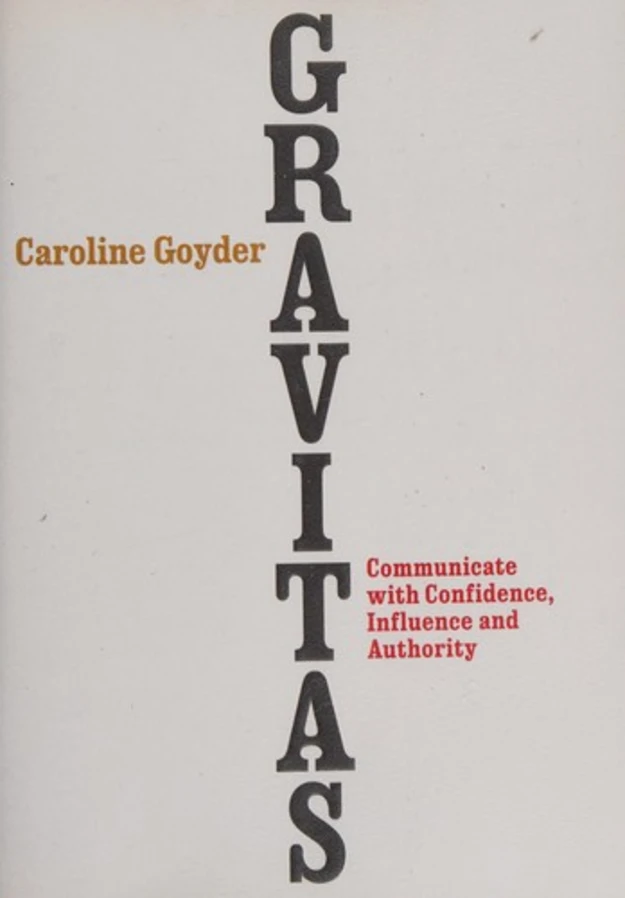
Gravitas
Communicate with Confidence, Influence and Authority
Author: Caroline Goyder
Demystifying the Art of Presence: A Review of Caroline Goyder’s “Gravitas”
After reading Sylvia Ann Hewlett’s Executive Presence, I was left with a strong desire to pull the thread further and understand the mechanics of how we project authority. That curiosity led me to Caroline Goyder’s Gravitas: Communicate with Confidence, Influence and Authority. If Hewlett defines the “what” of gravitas, Goyder provides a highly practical framework for the “how.”
What resonated most deeply with me in Goyder’s work is her elegant summation of the concept. She distills it down to a simple, actionable equation:
Gravitas = Knowledge + Purpose + Passion – Anxiety
This formula profoundly shifted my perspective, particularly the absolute necessity of the “Knowledge” cornerstone. Without deep, grounded knowledge, attempting to demonstrate gravitas easily tips into hollow posturing.
As an Engineering Manager, this triggered a lot of personal reflection. In tech leadership, there is a constant, delicate balancing act regarding knowledge. How deep do you dive into the weeds to genuinely wield the power of that knowledge, versus how much do you step back and leverage your Tech Leads? It immediately brought to mind Will Larson’s Staff Engineer, specifically his discussion of the “Hand of the King” archetype and the absolute necessity of getting a grounded, undeniable understanding of your specific domain. You cannot fake the “Knowledge” variable in Goyder’s equation when leading engineers.
While Goyder’s formula identifies “Anxiety” as the great subtractor of gravitas, I felt the book only scratched the surface of where that anxiety truly stems from in a corporate environment. To fill that gap, I found myself connecting Goyder’s framework to Jeffrey Pfeffer’s book Power. In my experience, the anxiety that strips away gravitas isn’t just stage fright; it is heavily tied to our ability—or inability—to tolerate conflict. True gravitas requires the stomach to stand firm in the face of disagreement.
Goyder’s background is in voice coaching, and there are significant portions of the book dedicated to the mechanics of breathing, tone, and vocal delivery. While these practical exercises are certainly useful, for me, the true value of the book lies in her broader articulation of what gravitas actually is.
Ultimately, this book reinforces a comforting truth: while gravitas may come effortlessly to a lucky few, for the rest of us, it is a learned behavior. And yes, it is a hard learning process. But the biggest takeaway is that the tools are available. When combined with the insights of Hewlett, Larson, and Pfeffer, Goyder’s Gravitas provides an excellent, structured framework for anyone willing to put in the work to acquire these essential leadership skills.